Journal6 min read
The Yoga Sutras of Patanjali: a beginner’s guide
Ask most people what the Yoga Sutras are about and they will guess postures. It is a fair guess. Yoga, for most of us, began on a mat. But of the 196 short lines that make up the text, three are about posture, and none of them describes a single pose.
The Yoga Sutras of Patanjali are about the mind. That is the first thing to know before you open them, and it changes how everything else reads.
What a sutra is
The Sanskrit word sutra means thread. A sutra is a short, compressed statement, often only a few words long, meant to be memorised and then unpacked by a teacher. The text was never designed to be read alone, cover to cover, like a modern book. It was a set of threads, and the commentary was the cloth woven from them.
Very little is known about Patanjali himself. Scholars disagree about when the text was compiled, and most place it somewhere in the centuries either side of the start of the common era. What survives is the work, and a long tradition of commentary on it, beginning with the Yoga Bhashya attributed to Vyasa.
This is why a first reading can feel strange. You meet a line like “practice and non-attachment” and wonder what you are supposed to do with it. The answer is that you are supposed to stay with it, and ask.
The four chapters
The sutras are arranged in four chapters, each called a pada.
- Samadhi Pada, on absorption: what yoga is, and what a settled mind looks like.
- Sadhana Pada, on practice: the causes of suffering and the eight limbs that address them.
- Vibhuti Pada, on the deeper stages of concentration and what they bring.
- Kaivalya Pada, on freedom: the final aim of the whole path.
A beginner does not need to start at the beginning. The first chapter is the most abstract. Many teachers bring students in through the second, because that is where the practical instruction lives.
The definition
The text opens with four words: atha yoga anushasanam, “now, the teaching of yoga”. That “now” has been read for centuries as a statement about readiness. The teaching begins when the student is ready to receive it, not before.
The second sutra is the one most students learn by heart: yogash chitta vritti nirodhah. Yoga is the stilling of the movements of the mind. Chitta is the mind in its widest sense, the whole field of thought, memory and feeling. Vritti are its fluctuations, the waves that move across it. Nirodha is their quieting.
Everything else in the text serves that one line. Ethics, posture, breath and meditation are all ways of letting the waves settle. The third sutra says what happens when they do: the one who sees rests in their own nature.
It is worth reading that slowly. Patanjali does not define yoga as flexibility, strength or calm. He defines it as a particular relationship with your own mind.
The eight limbs
In the second chapter (2.29) Patanjali sets out the path most people have heard of without knowing where it comes from: ashtanga, the eight limbs.
- Yama, restraints in how we treat others: non-harming, truthfulness, not stealing, moderation and non-grasping.
- Niyama, observances in how we treat ourselves: cleanliness, contentment, discipline, self-study and surrender.
- Asana, posture.
- Pranayama, the regulation of the breath.
- Pratyahara, the drawing inward of the senses.
- Dharana, concentration: holding the mind to one place.
- Dhyana, meditation: that concentration becoming a steady flow.
- Samadhi, absorption.
Notice where posture sits. Third, after two limbs about how you live. A class that begins with asana is, in Patanjali’s terms, starting part of the way in.
And when he does reach posture, he gives it one definition (2.46): sthira sukham asanam. The seat should be steady and comfortable. Then, in the two sutras that follow, the posture is mastered by relaxing effort, and the student is no longer disturbed by the pairs of opposites, heat and cold, pleasure and discomfort. That is the whole of it. The point of the seat is to let you sit still long enough for the inner limbs to begin.
Three sutras to start with
You do not need to read all 196 to begin. These three repay a lifetime of attention.
1.12: practice and non-attachment. The movements of the mind are quieted by abhyasa, steady practice, and vairagya, letting go. One without the other fails. Practice without letting go becomes grasping. Letting go without practice becomes drift.
1.33: four attitudes. Friendliness towards the happy, compassion towards those who suffer, gladness at the good in others, and equanimity towards those who do harm. Patanjali offers these as ways to keep the mind clear. Try them for one day in an office and you will see why he thought it necessary.
2.33: the opposite thought. When disturbed by harmful thoughts, cultivate their opposite, pratipaksha bhavana. It is the simplest instruction in the text and among the hardest to remember at the moment it is needed.
How to read them
Read slowly, and read with a commentary. A bare translation of the sutras fits on a few pages and will tell you very little. A good commentary sets each line in the tradition it came from, and shows you where the translators disagree.
Read one sutra, then stop. Carry it through a day. Notice when it applies and when it seems not to. The text was memorised for centuries precisely so that it could be carried in this way, and returned to in the middle of an ordinary afternoon.
Above all, read them with a teacher if you can. The sutra was the thread. The teacher was always the one who wove it.
A practice for this week
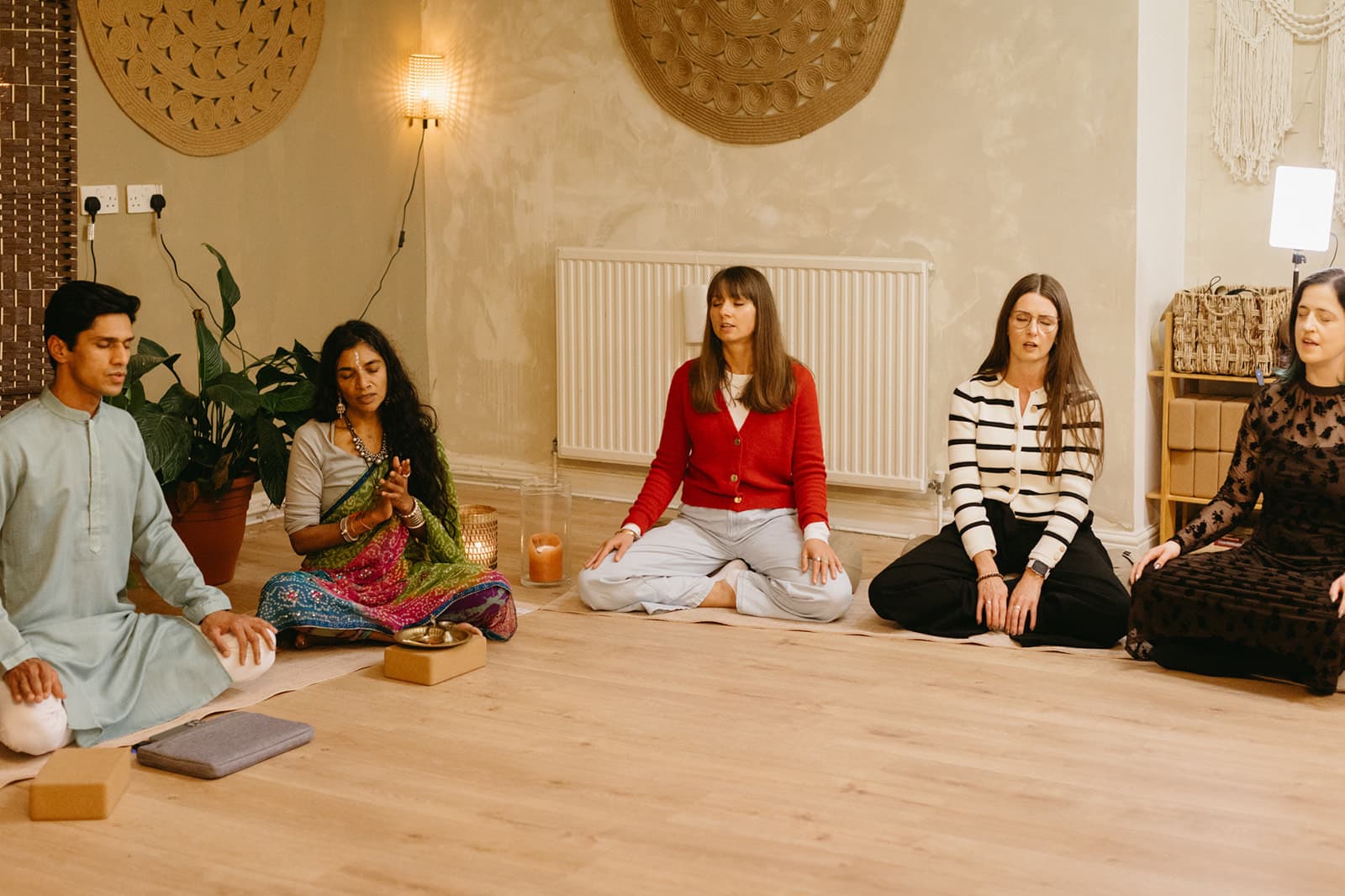
Take the second sutra: yogash chitta vritti nirodhah. Each morning, before you look at your phone, sit for five minutes and simply watch the mind move. Do not try to stop it. Count the waves if it helps: a plan, a memory, a worry, a sound outside. At the end, say the sutra once, quietly.
By the end of the week you will understand the line far better than any translation could explain it.
The Yoga Sutras sit at the centre of the philosophy studied on our 200-Hour Yoga Teacher Training, alongside the Hatha Pradipika and the Bhagavad Gita.
Study this furtherThe 200-Hour Yoga Teacher Training