Journal5 min read
What a weekend yoga teacher training is really like
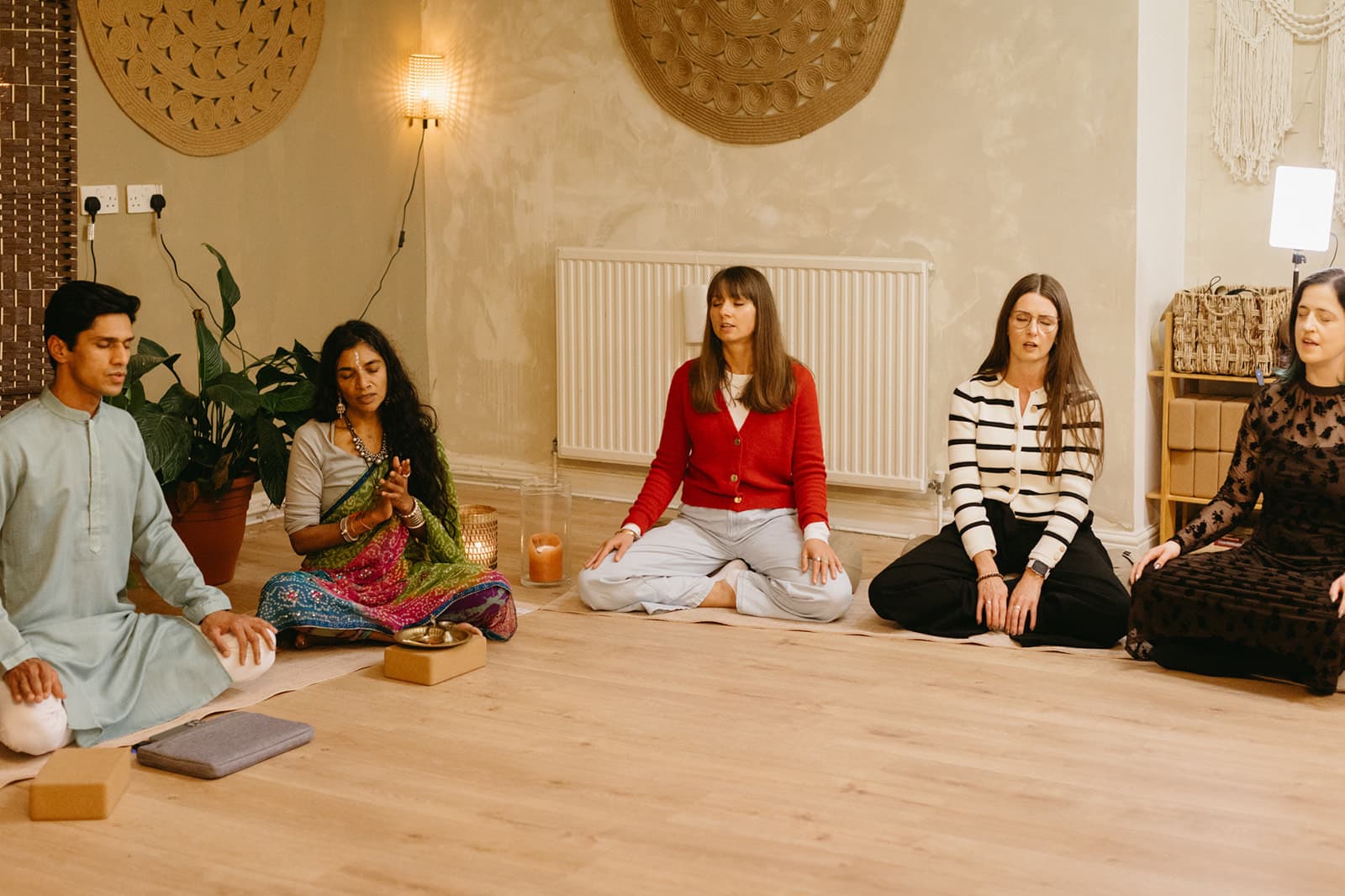
Most people who sign up for a weekend teacher training picture the weekends: the studio, the group, the long afternoons of practice. Few picture the Tuesday evenings in between. That is where a good part of the training actually happens.
Here is what the format asks of you, week by week, and what it gives back.
The shape of it
A weekend training spreads 200 hours across months rather than weeks. Ours runs over ten weekends in Rhyl, on the North Wales coast, from 23rd January to 28th March 2027, every Saturday and Sunday from 12pm to 6pm. There are no weekends off in the middle.
Two things follow. You keep your ordinary life: work, family and home carry on, and the training is laid over them rather than replacing them. And that ordinary life does not pause to make room. Some weekends you will arrive tired, distracted, or carrying a week that went badly.
That is part of the training too, though it rarely makes the brochure.
Saturday and Sunday
A six-hour training day is not six hours of postures. The time is shared between everything a 200-hour course has to cover: asana, the postures; pranayama, the regulation of the breath; meditation; anatomy; philosophy; and the craft of teaching itself. Part of the day you practise. Part of it you sit with a notebook. Before long you are standing at the front of the room, teaching a short sequence to people who are learning exactly what you are.
The first time is awkward for almost everyone. Instructions come out in the wrong order, you forget which side you started on, and the breath cues arrive a beat late. Then you do it again the next weekend, and the one after that.
The two days feel different. On Saturday the material is new and the attention comes easily. By Sunday afternoon your body has done two days of practice, your head is full, and the work is to keep paying attention anyway. Learning to stay steady when you are tired turns out to be good preparation for teaching, which so often happens at the end of someone else’s long day.
The weeks in between
Between weekends the course keeps going. Ours includes two live philosophy sessions each week, recorded so that you can catch up if you miss one. The Yoga Sutras of Patanjali, the Hatha Pradipika and the Bhagavad Gita do not fit into a weekend. They need to be read, left alone for a few days, and read again.
Then there is your own practice. Patanjali calls it abhyasa, steady practice, and in sutra 1.14 he says it becomes firmly grounded only when it is kept up for a long time, without interruption, and with care. A weekend course tests the middle condition more than any other. Nobody is watching on a Wednesday. Whether you unroll your mat before work is entirely up to you.
This is the real advantage of the slower format. You learn a sequence on Saturday, practise it alone on Tuesday, find the place where it stops making sense, and bring the question back the following weekend. Material that arrives in a hurry tends to leave in one. Material you have lived with for a week stays.
What it asks of the people around you
Ten consecutive weekends is a long time to be unavailable on a Saturday. Before you apply, sit down with the people you live with and go through the dates together: the birthdays, the family visits, the weekend shifts at work.
Attendance matters. To graduate from our course you attend at least 90% of it, and catch-up classes for anything missed beyond that carry an additional charge. Far better to find the clash in November than in February.
What changes over ten weeks
Somewhere in the middle of the course, the training stops being something you go to and becomes something you carry. You notice how you are breathing in a queue. A posture you have practised for years looks different once you have had to explain it, out loud, to someone whose body does not move like yours.
At the end come written and practical assessments. They check that you can do what the certificate says you can: teach a led class, including basic pranayama and meditation, safely and clearly. Avana Yoga is a Yoga Alliance Registered Yoga School, so on successful completion you can register with Yoga Alliance as an RYT 200, a Registered Yoga Teacher.
Is the weekend format right for you?
It suits people who cannot step away from their lives for a month, and people who learn best by trying things out between lessons. It suits less well anyone whose weekends are already spoken for, or anyone who wants to be immersed completely and think of nothing else. For them, a residential intensive may be the better choice.
Our groups are small, so the trainers can watch you teach and notice when you are struggling. The early-bird fee for the January course is £1,899 until 30th November 2026, then £2,099, and payment plans are available on request.
A reflection before you apply
Open your diary at the last week of January and turn the pages slowly, one weekend at a time, to the end of March. At each one, ask what would have to move for you to be in Rhyl from noon until six, both days.
If the answer is very little, the format will probably hold you well. If the answer is a great deal, notice how that feels before you decide anything. That feeling is information.
The dates, the full curriculum and the application form are on the 200-Hour Yoga Teacher Training page.
Study this furtherThe 200-Hour Yoga Teacher Training