Journal5 min read
Why hiking and yoga belong together
Ask people what they picture when they hear the words yoga retreat, and most describe a room: mats in rows, a teacher at the front, perhaps a view through the window. Ask the same people what they remember from a week in the mountains, and they describe the walk.
The two are usually kept apart, as if one were practice and the other a holiday. In the tradition they were never separate. Yoga grew up among people who walked, and much of it was carried from place to place on foot.
Yoga was always practised on the move
For centuries many of India’s yogis were wanderers. The sannyasi, the renunciate, kept no fixed home. By custom he stayed in one place only for the four months of the monsoon, chaturmasya, when the roads were impassable, and walked for the rest of the year.
Ordinary householders walked too. Tirtha yatra, pilgrimage, means a journey to a tirtha, a crossing place, usually a river or a sacred lake. The journey on foot was part of the practice: long hours of walking, a mantra repeated under the breath, attention held on the road ahead.
The mountains hold a particular place in this story. Rishikesh and Haridwar sit where the Ganges leaves the Himalayas for the plains, and generations of practitioners have walked from there up into the valleys to study and to sit.
What the Bhagavad Gita says about balance
In the sixth chapter of the Bhagavad Gita, Krishna tells Arjuna that yoga is not for someone who eats too much or too little, or who sleeps too much or too little. It is for the one who is yukta, measured, in food and in vihara, recreation and movement, in effort, and in sleep and waking (6.16–17).
A day that joins practice and walking is a fairly literal answer to those two verses. The morning practice prepares the body and settles the mind. The walk uses the body fully, in the open air, for hours. The evening practice is slow and quiet, and sleep comes easily. Nothing is taken to excess, and nothing is left out.
What each gives the other
Walking in the mountains asks a great deal of the legs and hips: long climbs, uneven ground, and the careful, braking work of coming downhill. A morning practice that opens the hips, wakes the ankles and brings the spine into movement is a natural preparation for it. After the walk, long-held and well-supported postures give the legs and lower back somewhere to rest.
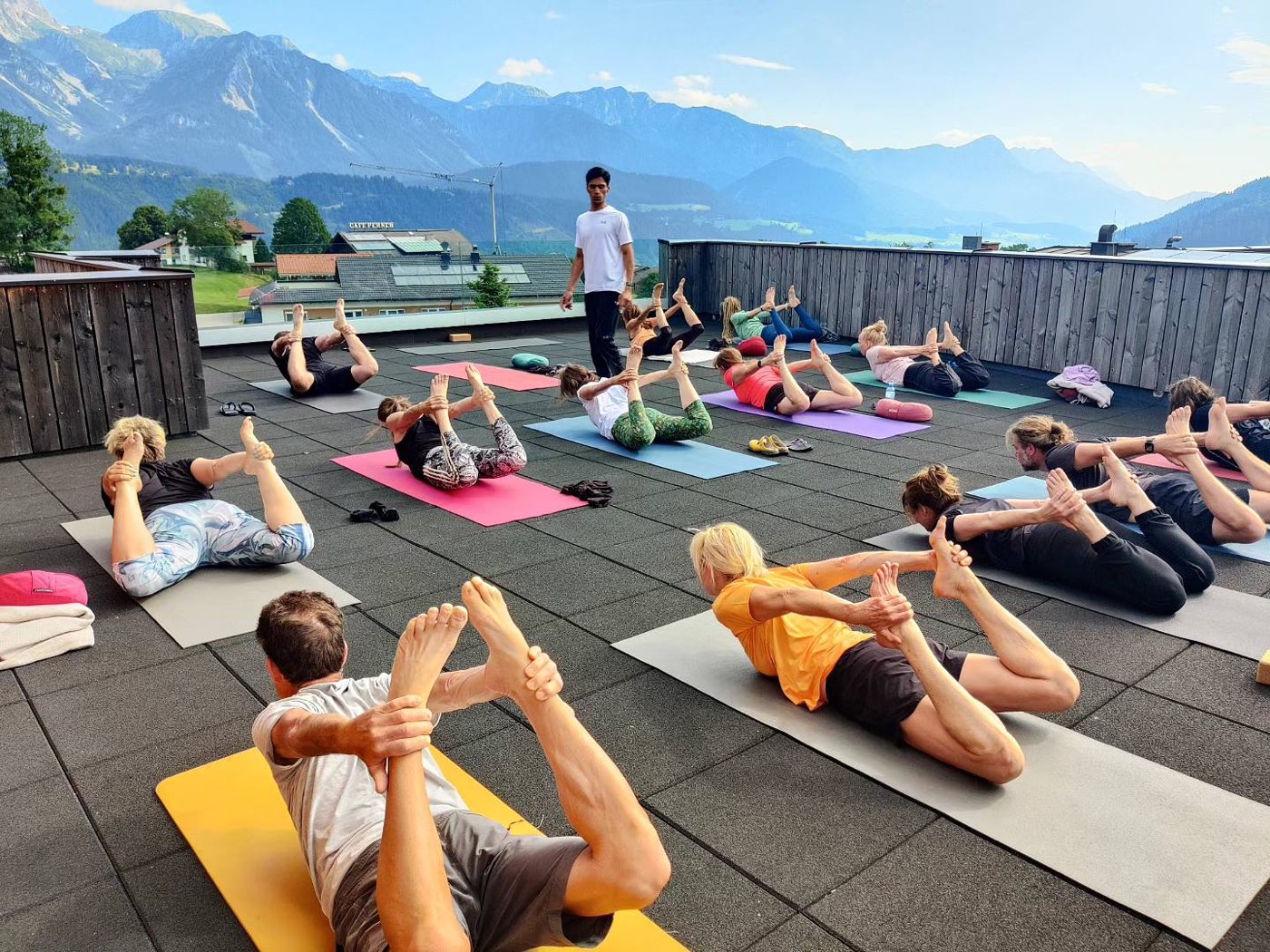
The exchange runs the other way too. On a steep path the breath takes charge. Talking becomes hard, and most walkers fall into a rhythm without deciding to: a few steps to each inhalation, a few to each exhalation. That is close to what yoga calls pranayama, the regulation of the breath, arrived at without instruction because the mountain asks for it.
A long walk also makes stillness easier. Many people who struggle to sit for ten minutes at home find that, after a day on the trails, meditation comes without a fight. The body has done its work and is content to be still, so the mind has less to push against.
Walking as meditation
You do not need a special technique to make a walk part of your practice. Choose a stretch of path, stop talking, and let the attention rest on three things in turn: the feet, the breath, the sounds around you. When the mind wanders, as it will, bring it back to the feet.
This is dharana, concentration, the sixth of Patanjali’s eight limbs. The Yoga Sutras define it as holding the mind to one place (3.1). A mountain path is a generous place to learn it, because the ground itself keeps calling the attention back: a loose stone, a root, a stream to cross.
Why the Alps
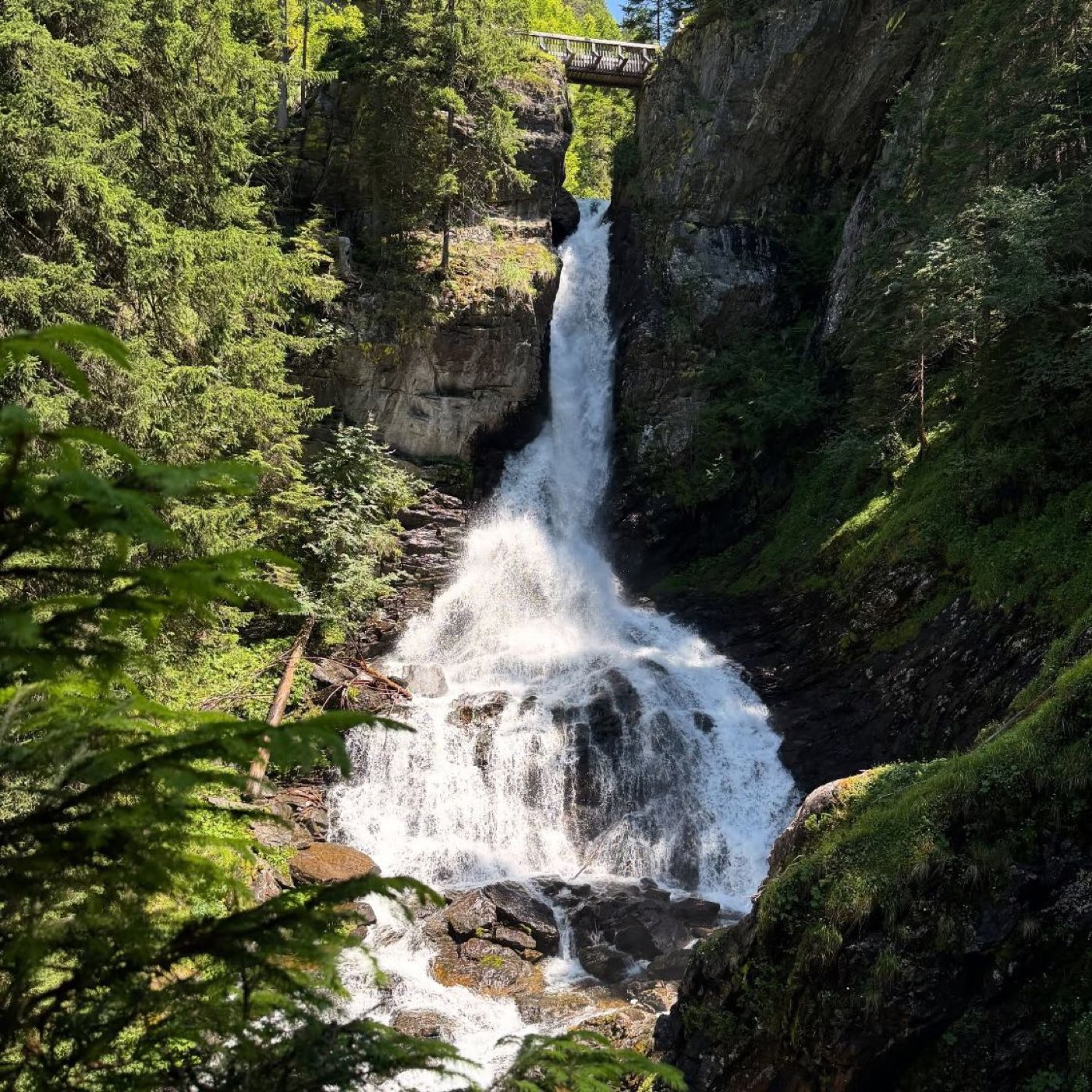
India’s yogis had the Himalayas. Europe has the Alps, within easy reach of most of the continent, and they suit this kind of practice well: clear air, long trails, lakes and meadows, and very little noise.
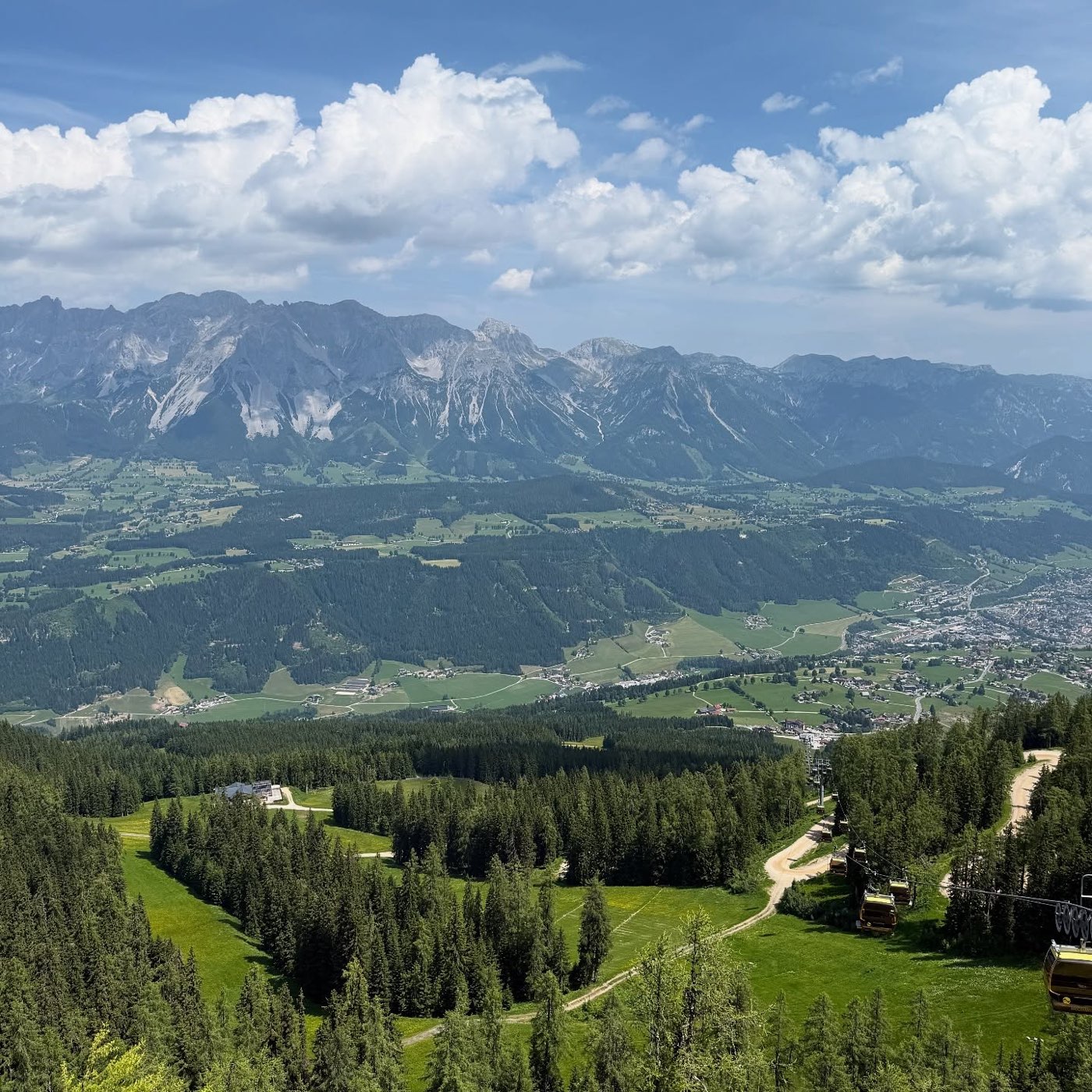
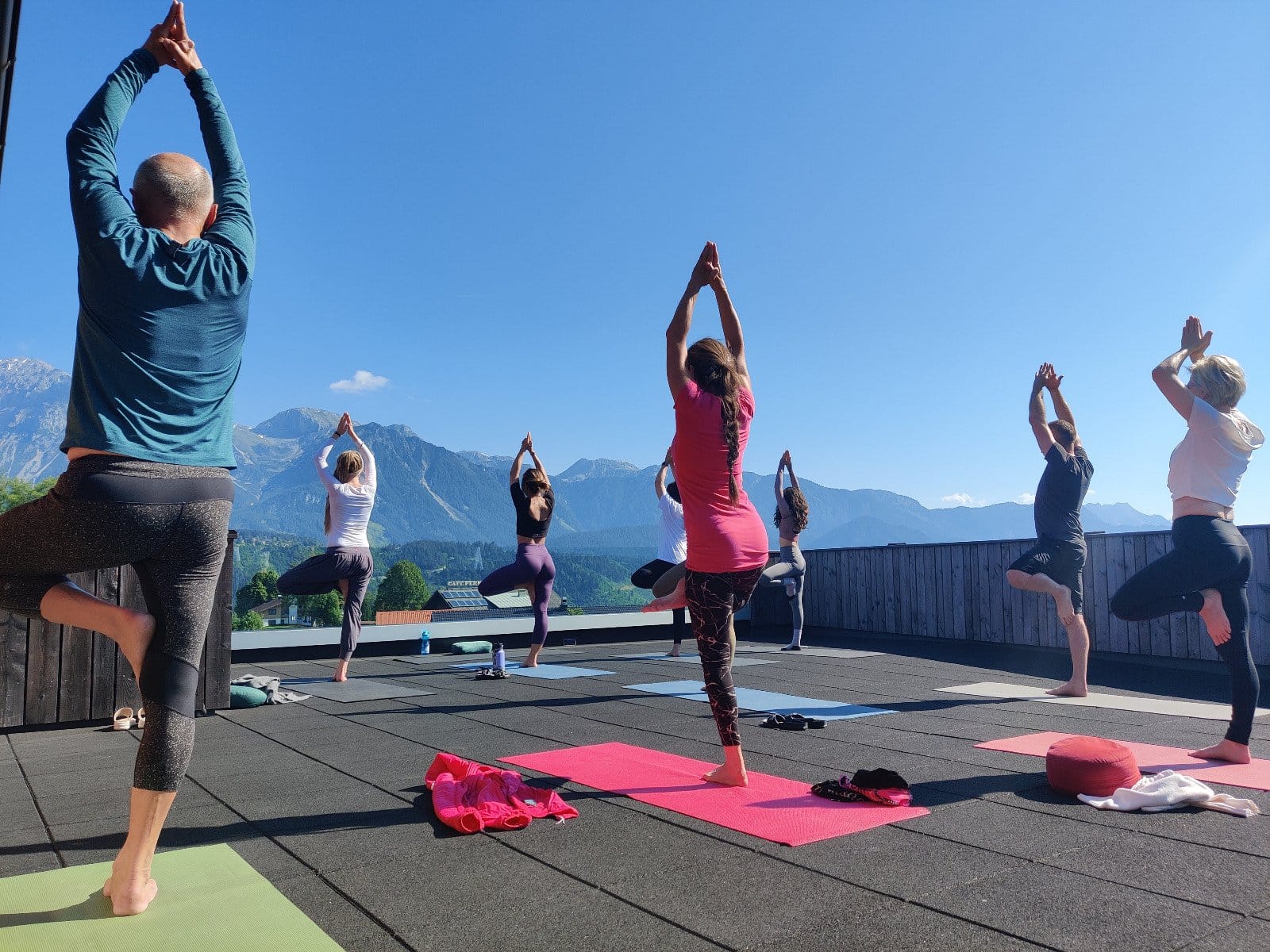
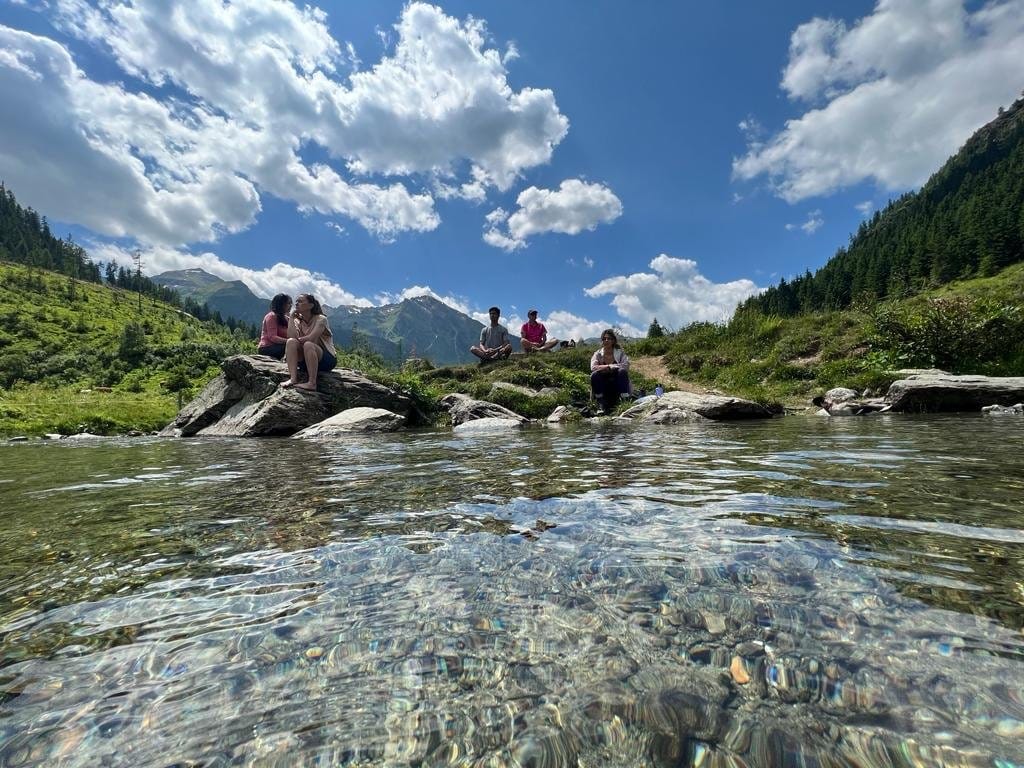
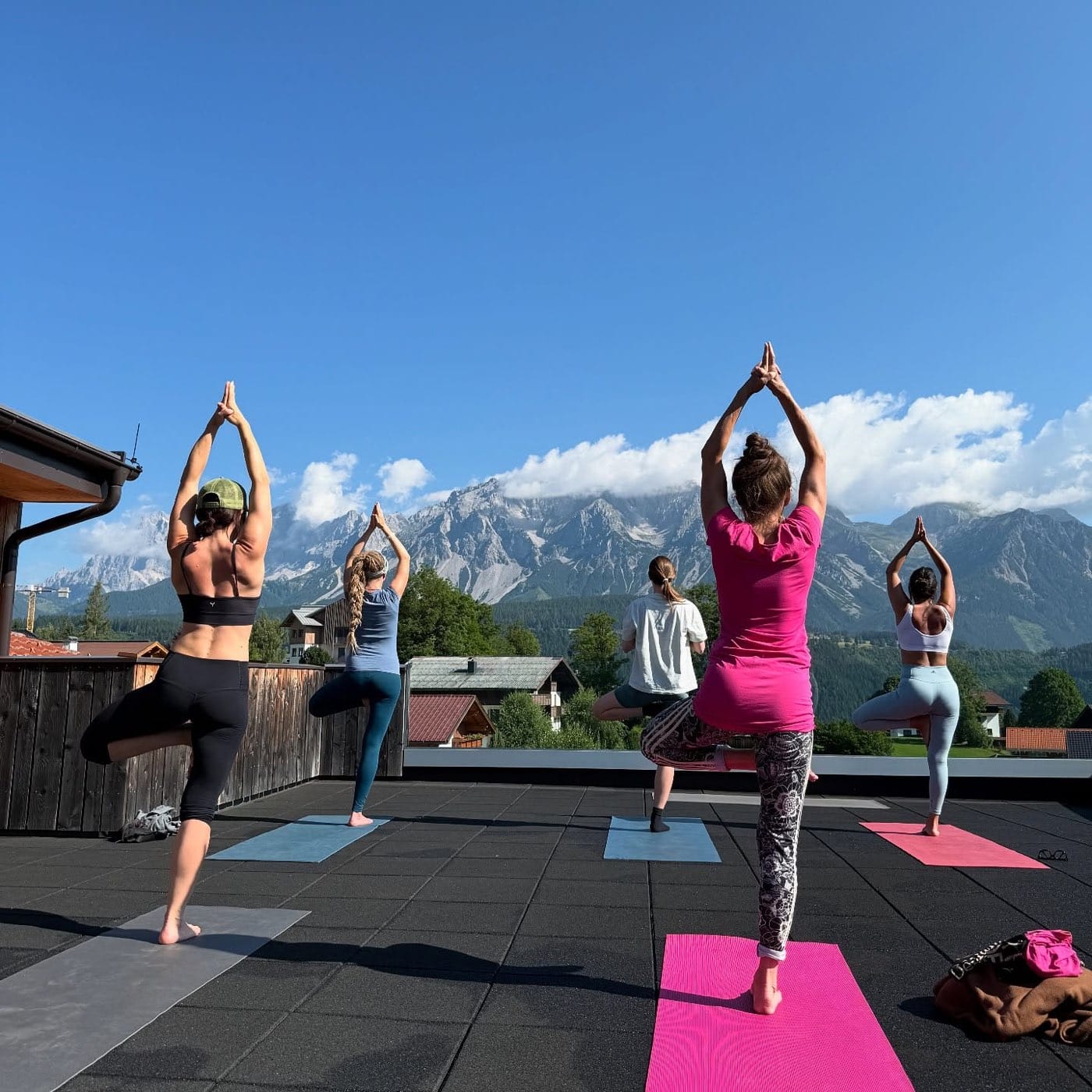
Our retreat is held in Rohrmoos-Schladming in the Austrian Alps, at an organic hotel facing the Dachstein. We practise with the mountains in view. In the day we walk, on trails, beside lakes and streams and across alpine meadows, with hiking backpacks and poles lent free. In the evening there is a shared vegan and vegetarian dinner, time to talk over the day, and a slow Yin or relaxation practice before sleep. The nearest airport is Salzburg and the nearest train station is Schladming.
Five days is not long. It is long enough to notice how much quieter the mind becomes when the day has a rhythm: practise, walk, eat, rest.
A practice to take with you
On your next walk, wherever it is, try this. For the first ten minutes, walk a little more slowly than usual. Let the breath set the pace: count how many steps fit an inhalation and how many an exhalation, and keep the two even. Then, for a few minutes, walk in silence with your attention on the soles of your feet. At the end, stand still, close your eyes, and notice how the body feels before you move on.
If you would like to spend five days practising this way, read about our Yoga & Hiking Retreat in the Austrian Alps.
Study this furtherOur Yoga & Hiking Retreat in the Austrian Alps